
Preparing for your engagement
Preparation decides how your audit goes.
Some associations get a finished report back in five or six weeks. Others are still chasing a bank confirmation three months later. The difference is rarely the auditor — it is whether the engagement letter was signed before year end, whether the year-end close was complete before fieldwork started, and whether the document package arrived in one organized delivery.
Request a Proposal Jump to the document request list
A timeline that meets the 90-day deadline
-
October – November
Engage the CPA before year end
Get the engagement letter signed and returned before December 31. The firm can plan your job into its schedule, and your manager knows who is auditing. Associations that wait until February join the back of a long line.
-
January
Close the year completely
Every bank account reconciled, receivable and payable agings tied to the balance sheet, transactions coded to operating or reserve funds, and the general ledger closed. Verify that bank signature cards were updated for any signer changes during the year. A complete close is the single biggest time-saver in the whole process.
-
January – February
Gather the document package, then fieldwork
The auditor requests a list of documents from you, sometimes called the PBC list; the complete request list is below. Fieldwork follows: reconciling accounts, testing transactions, reading minutes, and asking questions as they come up.
-
February – March
Review the draft and sign the representation letter
The board reviews draft statements and any proposed adjustments, then the officers your CPA designates — typically the president and treasurer, along with the manager — sign the representation letter. No CPA can release a final report without it, so do not let it sit in an inbox.
-
By March 31, delivery by April 30 for an HOA
Final report issued and delivered to members
Report complete within 90 days of year end. Members receive a copy, or a notice of availability, within 21 days of completion — and no later than 120 days after year end for an HOA, 180 days for a condominium.
The document package
Your auditor will send a document request list, sometimes called the PBC list. It comes in two parts: the board and governance records, which the board, the manager, or the association’s attorney usually holds, and the accounting package from the manager or bookkeeper.
The complete list runs to roughly sixty items, from the declaration and board minutes through to bank reconciliations, the reserve activity schedule, and the general ledger for the months after year end. Rather than reproduce it here, it is set out in full on pages 6 and 7 of the preparation guide, organized so a bookkeeper can start assembling the package before the auditor asks for it.
The full document request list is in the guide. Download it below, or jump straight to it — part one covers board and governance records, part two the financial records.
Six avoidable delays
These come up again and again, and every one is preventable.
Engagement letter signed late
December 31 year ends pile up on every CPA's desk at once. An association that signs in February gets February's leftover capacity.
FixApprove and return the engagement letter before your fiscal year ends.
Books kept on a cash basis
Year-end statements are prepared on the accrual basis under GAAP. Cash-basis books need adjusting entries for assessments receivable, prepaid assessments, and unpaid bills, and every adjustment adds questions.
FixAsk your bookkeeper to record receivables and payables monthly, or at minimum at year end before the package goes out.
Unreconciled or partly reconciled accounts
A reconciliation that does not tie to the bank statement and the balance sheet means the auditor has to chase the difference.
FixReconcile every account every month, and have someone who does not handle cash review the reconciliation.
Missing invoices and undocumented approvals
Sampled expenses need a matching invoice and evidence of approval. Every missing document becomes an open item somebody has to track down.
FixFile invoices as they are paid. Record board approval of large or over-budget spending in the minutes.
Operating and reserve activity tangled together
Reserve expenses paid from operating and never reimbursed, or transfers with no paper trail, force the auditor to rebuild the interfund balance.
FixKeep separate bank accounts, code every transaction to a fund in the general ledger, and reconcile interfund balances monthly.
The representation letter sits unsigned
The final report cannot be released without it. Hesitation at the finish line quietly adds weeks.
FixPut it on a board agenda in advance. New directors can sign: the letter's assertions are made to the best knowledge and belief of the person signing, so a new director is not vouching for events before their time.
Questions for the board to ask every month
The easiest audits happen at associations that never need a January catch-up. Put these questions to your monthly financial package.
- Does every bank reconciliation tie to both the bank statement and the balance sheet?
- Are operating and reserve funds separately stated, in separate accounts?
- Does the delinquency report tie to the balance sheet, and is the collection policy being followed?
- Does the payables aging include all known unpaid bills?
- Were all reserve expenditures, including change orders, approved by the board and recorded in the minutes?
- Was any over-budget spending approved and documented?
- Has the association borrowed from reserves for operating needs, and if so, is there a documented repayment plan?
- Do loan balances tie to the lender's statements?
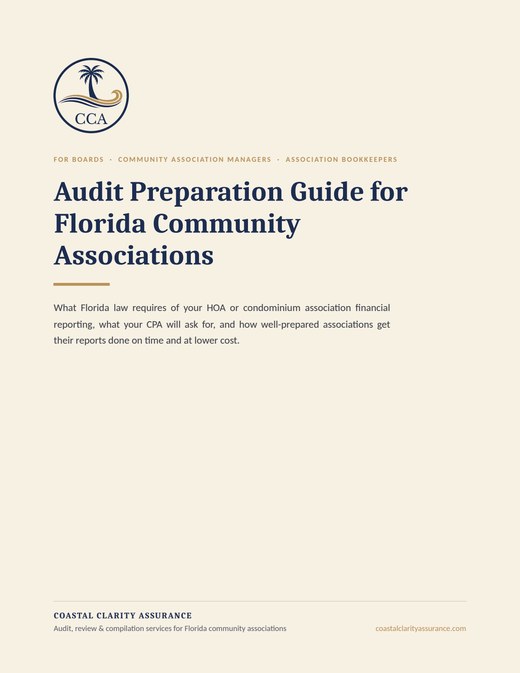
Take the whole guide with you
Everything on this page in a single document, plus the four reporting levels, the statutory tiers and deadlines, and the questions boards ask most often. Free, no email address required. Managers are welcome to forward it to every board they serve.
Tell us your revenue figure and we will tell you what you need.
Send your association's total annual revenue and fiscal year end. We will confirm the required reporting level and provide a fixed-scope proposal.
Or call (754) 354-3231